
What sales promises, the factory must be able to deliver.
When customer agreements, specifications and commercial information still move manually between sales, engineering, ERP and production, complexity grows faster than the company. Blue Kanvas builds the commercial and digital infrastructure that makes customer demand, quote, order and execution work as one process.
Commercial structure · AI Workflow Automation · Scalable execution
For growing B2B manufacturers that want to depend less on manual work and individual knowledge.
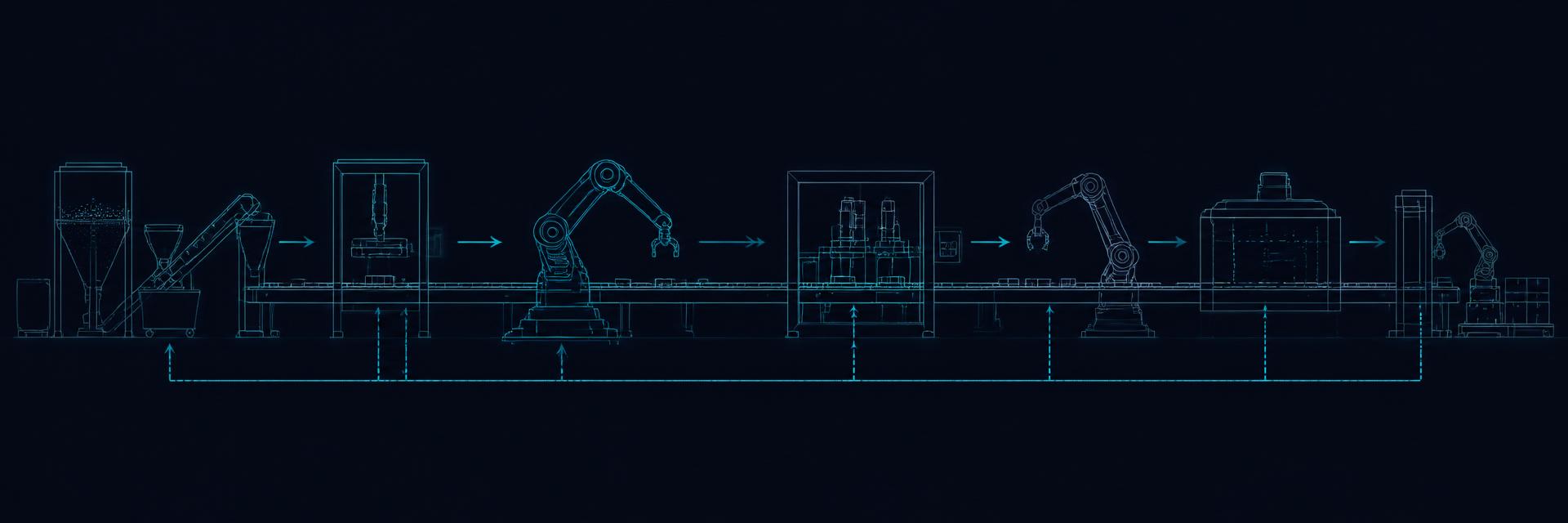
How much knowledge does your organisation have to reassemble every single day?
Customer knowledge sits with people
Account managers and management know what customers care about, but that context is not always part of the process.
RFQs create a lot of coordination
Sales, engineering, calculation and operations have to gather information manually before a proposal can be made.
Systems do not tell the whole story
ERP, CRM, email, documents and spreadsheets each hold part of the same customer or order information.
Handovers create errors and delay
What was discussed commercially has to be interpreted before production or operations can move on.
Growth means more alignment
More customers and orders bring extra meetings, emails, checks and exceptions.
You probably do not need yet another system.
You need a better information flow between customer, commercial teams and operations.
The problem usually sits between the systems.
Most manufacturers already have ERP, CRM, planning, document management, email, spreadsheets and project or engineering software. But the processes in between still depend on people.
Information still has to be collected, interpreted, copied, checked, routed, enriched and followed up. The objective is not to replace your core systems, but to make the workflow between them work.
Blue Kanvas works in the layer between your existing systems.
First define how the work should run. Then automate.
Structure
Build the commercial and operational frameworkDefine how customer opportunities and requirements should move through the organisation:
- Customer segmentation
- RFQ qualification
- Opportunity ownership
- Sales stages
- Engineering involvement
- Quotation approval
- Commercial responsibilities
- Customer requirements
- Handover criteria
- Order readiness
- Exception management
- Forecasting
- Management KPIs
Make clear which information is needed when, and who owns the next step.
Automate
Let information flow automaticallyOnce the operating process is clear, AI workflow automation removes repetitive work between systems and teams:
- RFQ → opportunity
- Email attachment → requirement extraction
- Customer meeting → CRM update
- Meeting → internal actions
- RFQ → engineering task
- Quotation sent → follow-up
- Customer response → opportunity update
- Won order → structured handover
- Customer requirements → ERP/project context
- Missing information → internal request
- Order update → customer communication
- CRM/ERP → management reporting
Let information move without employees processing the same data over and over.
Scale
Scale with AI Workflow AutomationOnce rules and processes are clear, AI Workflow Automation increasingly monitors and prepares the work:
- Review RFQs for completeness
- Flag missing specifications
- Collect customer information
- Run account research
- Prepare quotation follow-up
- Summarise customer context
- Check order handovers
- Detect deviations
- Prepare management summaries
- Track open actions
- Extract relevant information from documents
- Escalate exceptions
Use people for technical and commercial judgement. Use AI for repetitive knowledge and coordination work.
AI Workflow Automation operates within clear business rules, permissions, approvals and human control.
From a manual chain to one information flow.
People connect the information flow
- Customer / RFQ
- Email + documents
- Sales
- Engineering / calculation
- Excel / ERP
- Quote
- Sales
- Order
- Operations / production
- Questions about customer agreements
- Management escalation
The process connects the organisation
- Customer / RFQ
- Commercial operating system
- Qualification + requirements
- Sales + engineering
- Quote
- AI workflow automation
- Order + structured handover
- ERP / operations / production
- Management visibility
AI Workflow Automation across the documented workflows
Less manual work. Better information. Fewer handover errors. More predictability.
From RFQ to order without unnecessary coordination.
For many manufacturers commercial complexity starts at the request. An RFQ often carries information about specifications, volumes, tolerances, planning, certification, material, price expectation, delivery terms and exceptions.
That information then has to be interpreted by several people before a commercial decision is possible.
- Specifications and tolerances
- Volumes and planning
- Certification and material
- Price expectation
- Delivery terms
- Exceptions
What I lock down
- Qualification rules
- Ownership
- Requirement extraction
- Workflow routing
- Approvals
- Follow-up
- Conversion measurement
- Win/loss information
- Expected order date
- Management visibility
The goal is not to respond faster to every RFQ. The goal is to move the right requests to a profitable order faster and more consistently.
A won order only creates value when production knows exactly what was sold.
Many operational problems start during the commercial phase. For example when:
- Customer exceptions only live in email
- Additional requirements were discussed verbally
- Important details are not structured
- Engineering assumptions are not visible
- Customer priorities are lost during handover
- The production team only receives transactional ERP data
- Changes are not routed consistently
Where AI workflow automation supports
- Extract customer requirements
- Structure meeting notes
- Identify promises and commitments
- Compare information for completeness
- Prepare order summaries
- Trigger internal approvals
- Check missing fields
- Route actions
- Maintain commercial context
Less interpretation after the order. More clarity before production starts.
Management should not have to assemble every exception by hand.
In many manufacturing companies senior management still acts as a coordination layer. They know which customers matter, which orders are sensitive, where margins are under pressure, which RFQs are strategic, which promises were made and where exceptions are likely.
That experience is valuable. But if the organisation cannot function without constant management intervention, it is hard to scale.
Blue Kanvas translates that knowledge into:
- Rules
- Processes
- Workflows
- Ownership
- Customer segmentation
- Escalation criteria
- Management signals
The goal is not to remove management from operations. The goal is that management is only involved where its judgement genuinely adds value.
AI is valuable when information automatically becomes work.
Manufacturing companies generate enormous amounts of business information: RFQs, specifications, emails, meetings, orders, drawings, documents and customer requests.
The opportunity is not simply to analyse that information. It is to automatically turn it into the next business action.
Example workflow
- 01RFQ received
- 02AI extracts the key requirements
- 03CRM / opportunity is updated
- 04Engineering is involved
- 05Missing information is flagged
- 06Actions are assigned
- 07The quotation process starts
- 08Management sees the status
From unstructured customer information to structured execution.
Blue Kanvas remains responsible for process design, commercial architecture, business logic, adoption and management outcomes. The execution layer can be delivered with technology from enzover.com.
Work that disappears from the process.
AI Workflow Automation connects existing people, processes and systems. People retain responsibility for commercial and technical judgement.
RFQ → structured processing
Reviews incoming RFQs, identifies relevant information and flags missing data.
Customer information → action
Collects customer, account and historical context before commercial interactions.
Sales → operations handover
Checks whether required commercial and technical information is complete before an order moves into operations.
Quote → follow-up
Monitors quotations and prepares relevant next actions.
ERP/CRM → management information
Surfaces exceptions, commercial risks and opportunities requiring management attention.
Information extraction
Finds approved customer, product and process information across internal sources.
Less manual work. Less handover loss. Better execution. More management visibility.
Your next growth opportunity is often already in your customer base.
Existing customers generate repeat orders, additional product lines, higher volumes, new locations, service, maintenance, spare parts, contract extensions and new applications.
But commercial development is often relationship-driven and dependent on individual account managers.
What Blue Kanvas structures
- Account segmentation
- Key account planning
- Opportunity signals
- Dormant account activation
- Installed base opportunities
- Customer follow-up
- Account reviews
- Cross-sell workflows
Make customer growth a process, not just a relationship.
See earlier what will enter the factory.
Management should have visibility from commercial opportunity through expected order intake. Not BI for the sake of BI, but better decisions about commercial focus, capacity and future workload.
- Qualified pipeline
- RFQ volume
- Quotation value
- Quotation conversion
- Opportunity ageing
- Win/loss reasons
- Expected order date
- Expected revenue
- Customer concentration
- Strategic accounts
- Pipeline by product group
- Upcoming demand
What changes?
Less dependency on key people
Customer and process knowledge becomes part of the organisation.
Less administrative coordination
Information moves more efficiently between commercial and operational teams.
Better order quality
Customer requirements and commercial agreements are transferred more consistently.
Faster commercial execution
RFQs, actions and quotations move through the organisation with less friction.
More management visibility
Commercial developments and exceptions become visible earlier.
More scalability
Additional business does not automatically require proportional coordination and overhead.
Recognisable?
- Sales and operations still work as separate worlds.
- Customer knowledge is concentrated in a few experienced employees.
- RFQs require substantial manual coordination.
- Information is copied between email, CRM, ERP and spreadsheets.
- Commercial agreements regularly need clarification after an order is won.
- Management is involved in too many exceptions.
- Forecasting future order intake is difficult.
- Account development is heavily relationship-dependent.
- Additional growth mainly creates more coordination.
- You have ERP and software, but the workflow between systems stays manual.
- You want to use AI where it reduces real work, not as another technology layer.
Then the biggest gain is probably not a new system, but organising the work between your existing systems better.
Where does the information flow stall between customer and factory?
In a first working session I map, together with you, where commercial information, handovers and systems cause unnecessary delay or dependency. Then I decide which process improvements and AI workflows create the most operational and commercial leverage.
30 minutes · concrete · focused on your current process
Get in touch
Tell me about your challenge. I respond within 24 hours.
I have no time for newsletters. Your details are only used to get back to you.